DA
Dr. Abhay Punia
Assistant Professor, Lovely Professional University, Department of Zoology, School of Bioengineering and Biosciences, Jalandhar, Punjab, India
What farmers had been reporting for years was quantified in a 2018 Science publication. For every degree Celsius of warming, yield losses to insect pests in wheat, rice, and maize increase by 10 to 25%. The temperate grain belts, where most of the world's grain is cultivated, face the greatest losses. Before those three crops are harvested, insects already consume five to twenty per cent of them.
I want to point out what that projection leaves out.
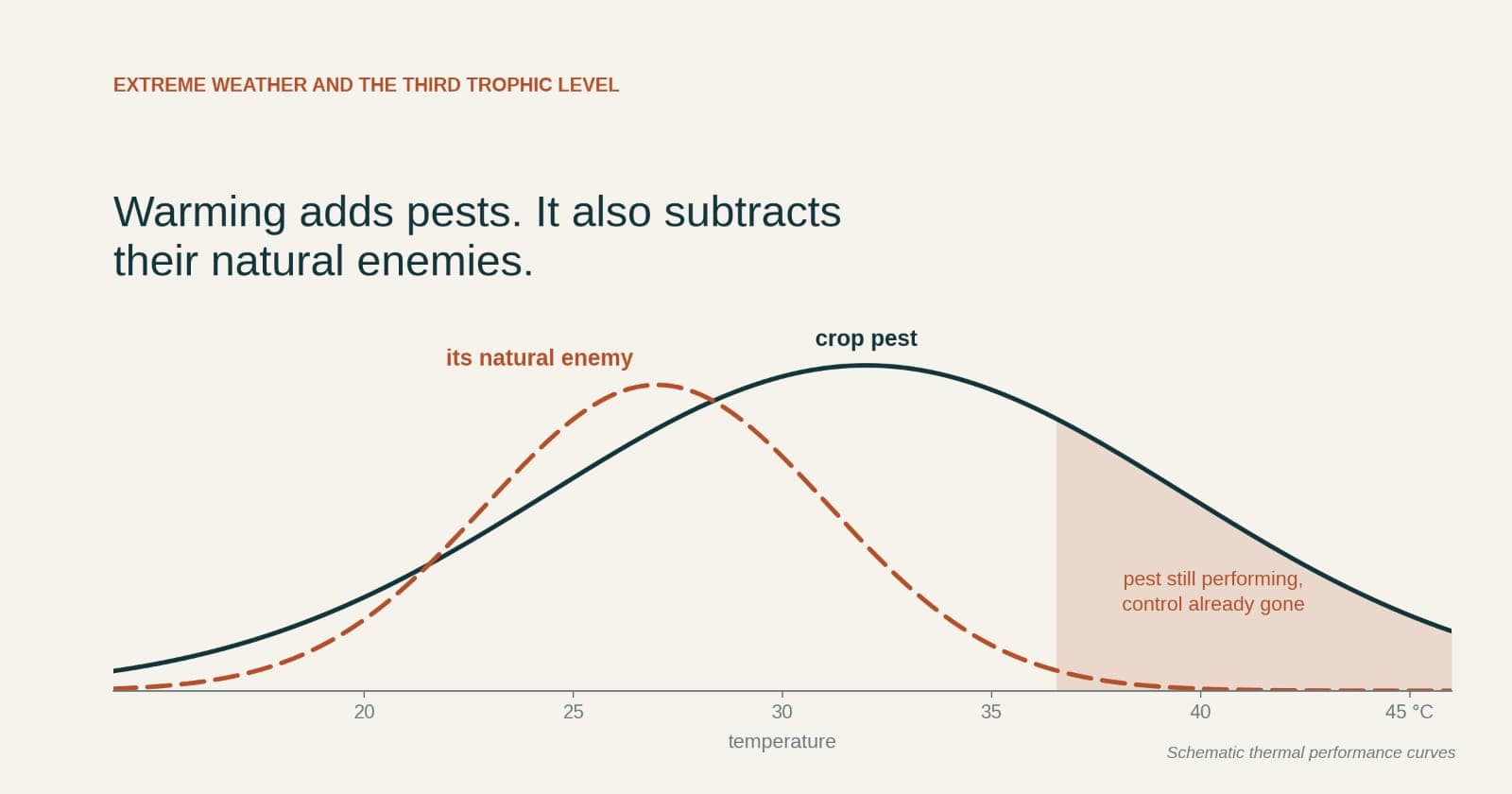
It was based on two recognized relationships: the response of insect metabolism to temperature and the response of insect population growth to temperature. The pests were treated with both. The parasitoids, predators, and entomopathogens that eat the pests were not treated with either. Season after season, the third layer in the majority of Indian farming systems contributes significantly to the reduction of pests at no cost to anyone. No invoice is sent to it. Additionally, no one checks to see if it survived the heatwave.
It makes sense to anticipate that the natural enemies will break first. A herbivorous pest requires a host plant, which is typically still standing when under heat stress. A parasitoid requires the pest at the appropriate developmental stage, location, and time. Because its life cycle is bound to that of another creature, it takes on all of the disruptions that organism encounters and adds its own.
This has been evident for almost twenty years in entomological literature. In a review that continues to be the standard, Hance and colleagues came to the conclusion that parasitoid thermal adaptations are limited by host responses, and that when host and parasitoid thermal preferences diverge, temporal or geographical synchronization breaks down and the risk of host outbreak increases. Additionally, parasitoids may lose their bacterial endosymbionts due to extreme temperatures. The pest experiences nothing comparable.
The issue is made worse by chemistry. A substance that reduced the target insect at concentrations close to 980 ppm hindered the growth of its larval parasitoid at around a quarter of that concentration, according to our own laboratory research on plant-derived phenolic compounds against lepidopteran pests. The helpful insect received absolutely no protection from the molecule's plant origin. Examine which of the two populations recovers after adding a heat event to that exposure.
Whitefly outbreaks in cotton from north India are typically categorized under "weather," which is an incomplete reading. What followed is the part worth remembering. ICAR's IPM validation trials in the Fazilka hotspot, built around conserving natural enemies and avoiding the insecticide classes most hostile to them, reported significant recovery of predator populations alongside a reduction of more than 68 per cent in the number of sprays and a yield increase above 18 per cent. The biological control was not gone. It had been suppressed, and it came back when the pressure came off.
The locust years make the same argument on a continental scale. Cyclones Mekunu and Luban flooded the Empty Quarter in 2018, and the desert locust bred there through three undisturbed generations, multiplying roughly eight thousand-fold before the swarms moved, eventually reaching Rajasthan and beyond in 2020. A recent assessment in npj Sustainable Agriculture traces the same causal chain from warm-season extreme rainfall to the soil moisture conditions that trigger gregarisation. An extreme weather event did not merely damage a crop. It manufactured a pest population on a scale no control system was resourced to meet.
India's agricultural early warning has improved considerably. We forecast heatwaves, we model the wheat losses that followed the hottest March since 1901, and pest surveillance networks count pest incidence against economic thresholds across thousands of locations.
What we seldom record is the parasitism rate. That single percentage, the share of pest larvae or nymphs carrying a developing parasitoid, is the field measurement that tells an entomologist whether biological control is still functioning. It is cheap to collect. A trained field assistant can do it with a hand lens and a rearing box. It does not appear on most advisory dashboards, which means that when a district's parasitism collapses after a heat event, the first indication we receive is the outbreak itself, several weeks later, when the only remaining option is a spray.
The gap runs through the supporting institutions too. Biocontrol agents are mass-reared in laboratories held near a constant twenty-six degrees, which quietly selects for lines with no particular tolerance for the conditions they will meet in a Punjab June. Release schedules follow the crop calendar rather than the weather forecast. And India's registration framework for biopesticides still leans on data requirements designed for synthetic molecules, with non-target testing on parasitoids and predators thin where it exists at all.
Add parasitism rate to routine pest surveillance and publish it by district alongside pest counts. It is a leading indicator, whereas pest incidence is a lagging one.
Screen and rear biological control agents under fluctuating and extreme thermal regimes rather than constant optima and report the thermal limits of released strains the way we report their host range.
Make non-target testing on parasitoids, predators and pollinators a registration requirement for biological inputs, including botanicals. Bio-based describes where a molecule came from, not what it does to the third trophic level.
Tie release advisories to short-range weather forecasts. Releasing a consignment of Trichogramma two days before a forecast heat spike wastes the consignment and the farmer's confidence together.
Climate resilience in Indian agriculture is currently discussed in terms of heat-tolerant varieties, micro-irrigation, insurance and forecasting, all of which matter. Sitting underneath them is an unpriced service delivered by insects that no ministry monitors and no budget line supports, and it is more thermally fragile than the pests it holds down.
We will notice its absence the way we always do as an outbreak, attributed to the weather, answered with a spray, followed by a slightly worse outbreak the next season. The instruments to avoid that sequence are neither expensive nor experimental. They are a percentage recorded in a field notebook, a rearing room that is allowed to get hot, and a registration form that asks one more question.
Disclaimer: The views expressed in this article are solely those of the author and do not necessarily represent the views, policies, or positions of the organisation.