
Dr. Anchita Borthakur
Researcher, Chintan Research Foundation (CRF), New Delhi
On 28 February 2026, when the United States and Israel launched "Operation Epic Fury" and "Operation Roaring Lion" respectively-a joint military campaign against Iran-discussions largely focused on the geopolitical implications of the conflict, rising energy prices, and disruptions to global energy supply chains and trade networks. However, alongside the geo-political parameters and growing human toll, this conventional military operation has also inflicted severe environmental damage in the region. As in most conflicts, ecological destruction-despite its long-lasting impacts spanning decades-often remains overlooked; this conflict is also no exception. A fragile ceasefire has now been initiated among the conflicting parties; however, the ecological footprint of war neither pauses nor adheres to such timelines. Its repercussions are already widespread and devastating, extending across the entire region.
Researchers from the Climate and Community Institute (CCI) estimate that the first 14 days of bombardment generated over 5 million tonnes of carbon dioxide equivalent (CO2e), surpassing Iceland's annual emissions of approximately 4.28 million tonnes. Within the first 10 days of the conflict, the Conflict and Environmental Observatory reported over 300 fire incidents detected through satellite-based monitoring systems, of which 232 were assessed for environmental risk, many concentrated around hydrocarbon infrastructure and oil facilities.
Reports indicate that multiple oil depots and refineries across Iran: the Aghdasiyeh oil warehouse in the northeast, the Tehran refinery in the south, the Shahran oil depot in the northwest, and a major fuel facility in Karaj involving related production and transfer centers, were struck by air raids, producing dense plumes of black smoke, releasing significant quantities of toxic pollutants into the atmosphere. Scientists caution that these hazardous emissions may pose long-term risks to both human health and the environment. Immediately following the incident, Iran's environmental agency, along with the Iranian Red Crescent Society, advised residents of Tehran to remain indoors, warning that toxic chemicals released from airstrikes on five fossil fuel facilities could result in acid rain and cause damage to skin and lungs. Subsequent rainfall reportedly carried soot and chemical residues, including sulphur compounds, nitrogen oxides, and polycyclic aromatic hydrocarbons, into the atmosphere, which also has the ability to contaminate soil, damage crops, and pollute groundwater for decades.
Source: TRT World
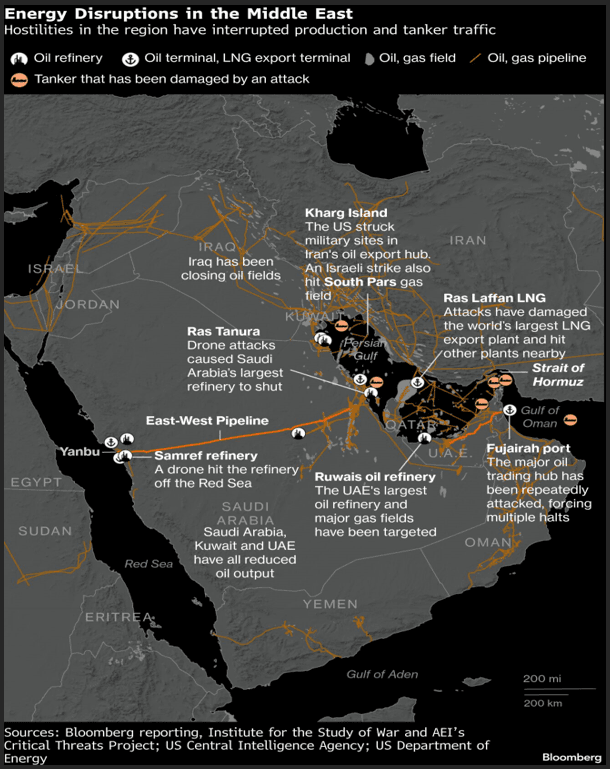
However, not only in Iran, but key energy infrastructure across West Asia has suffered significant damage due to the conflict. Major oil and refining hubs-including Ruwais in the UAE, one of the world's largest refineries; Samref and Ras Tanura in Saudi Arabia; the Gulf Petrochemical Industries Company and Bapco Energies facilities in Bahrain; Kuwait National Petroleum Company, Petrochemical Industries Company, and the Mina Al-Ahmadi and Mina Abdullah refineries in Kuwait; as well as the Lanaz plant in Iraq-have all been affected by warfare. Critical oil fields such as Majnoon in Iraq and Shaybah in Saudi Arabia have also been repeatedly targeted.
The United States and Israel also struck Iran's largest petrochemical complex in Mahshahr, the environmental consequences of which may persist for years. Similarly, Iranian missile and drone strikes on critical infrastructure across West Asia-including oil and petrochemical facilities in Kuwait, Bahrain, and the UAE-have caused significant environmental degradation in the entire region.
In March, Israeli airstrikes targeted sections of the South Pars Gas Field-the world's largest natural gas field-triggering fires and raising concerns over large-scale methane leakage and regional supply chain disruptions. Gas infrastructure across the region-including Ras Laffan in Qatar and key UAE facilities such as Habshan, and Shah-has also sustained direct damage as a result of the conflict. Preliminary assessments indicate that damage to major gas facilities could release millions of cubic metres of methane per day. Given that methane has a global warming potential 28-34 times higher than carbon dioxide, the resulting climate impact is both immediate and substantial.
In addition, major aluminium production facilities, including Al Taweelah in the UAE, Alba in Bahrain, and Mobarakeh in Iran, have sustained damage or destruction due to warfare, further accelerating environmental degradation through energy-intensive losses, emissions, and potential industrial contamination. Since the onset of the conflict, environmentally significant incidents have been reported not only in Iran but also across Iraq, Israel, Kuwait, Jordan, Bahrain, Qatar, the UAE, Saudi Arabia, Oman, Cyprus, and Azerbaijan. This demonstrates the spillover effect of the ongoing conflict. The environmental consequences of this destruction are profound and far exceed conventional estimates, underscoring a crisis that is difficult to fully comprehend.
According to the World Health Organization, "damage to petroleum facilities risks contaminating food, water, and air-hazards that can have severe health impacts, especially on children, older persons, and individuals with pre-existing medical conditions."
Many of these cities, including Tehran, which is bearing the brunt of the crisis, already suffer from poor air quality. Consequently, continued attacks on oil infrastructure are likely to expose millions to acute respiratory risks. Moreover, pollutants may seep into soils and groundwater aquifers, further exacerbating environmental degradation and public health challenges.
The Bushehr power plant-Iran's only operational nuclear facility-has reportedly come under repeated attacks during the ongoing conflict, raising fears of a potential nuclear incident that could prove catastrophic for the Gulf region. A strike on a nuclear reactor or spent fuel storage facility could release radiological particles, particularly the hazardous isotope Caesium-137, into the atmosphere. Such particles can disperse widely through wind and water, contaminating food, soil, and drinking water sources for decades. Direct exposure to such radiation can cause severe burns and increase the risk of cancer. In addition, radioactive contamination may also have serious implications for the marine ecosystem.
Attacks on naval vessels also pose significant risks to fragile marine ecosystems, including coral reefs, seagrass beds, and vulnerable species. The Persian Gulf, one of the world's most environmentally fragile marine regions, is home to diverse species such as fish, pearl oysters, green turtles, and the world's second-largest population of endangered dugongs. Oil spills from damaged vessels-often carrying billions of litres of crude oil-can persist for extended periods, threatening regional biodiversity. Several Iranian ships have reportedly been struck during the conflict, potentially becoming long-term sources of pollution. In late March, a Kuwaiti oil tanker off the coast of Dubai was also hit by drone fire, raising concerns of its environmental ramifications.
However, the more insidious threat lies beneath the surface, where sunken vessels may gradually release trapped fuel over months or even years, causing persistent contamination that is far more difficult to detect, monitor, and contain. Such environmental degradation would also adversely affect the livelihoods of fishing communities in the long run.
One of the most significant consequences of the current conflict is its impact on already scarce freshwater resources in the region. West Asia is among the most arid regions in the world, with Gulf populations heavily dependent on desalinated water for daily consumption.
It is estimated that eight of the world's ten largest desalination plants are located in the Arabian Peninsula. Qatar derives approximately 99 percent of its drinking water from desalination, while Bahrain relies on it for over 90 percent. For Kuwait, Oman, Saudi Arabia, and the UAE, dependence levels stand at approximately 90 percent, 86 percent, 70 percent, and 42 percent, respectively. As a result, attacks on desalination facilities pose a direct threat to water security for millions living in harsh desert conditions. Desalination plants in Kuwait and the UAE reportedly sustained damage from missile and drone strikes early in the conflict. Subsequently, facilities in Bahrain and Iran have also been targeted. Iran's Foreign Minister Abbas Araghchi accused the United States of committing "a blatant and desperate crime" by attacking a freshwater desalination plant on Qeshm Island, which disrupted water supplies to 30 villages. Collectively, these developments are pushing an already water-scarce region toward a severe water crisis in the future.
However, attacks on desalination plants and energy infrastructure in the Gulf are not unprecedented. During the Gulf crisis of the 1980s and the Iraq-Kuwait conflict in the 1990s, much of the region's desalination capacity was destroyed. These conflicts also saw widespread targeting of oil tankers and other platforms like oil depots, resulting in massive oil spills.
In the 1991 Gulf War, Iraqi forces set fire to approximately 700 oil wells in Kuwait during their retreat, with fires burning for months and causing extensive pollution. Similarly, the burning of Iraq's Qayyarah oil fields during the ISIS conflict had severe environmental consequences. Reports suggest that petroleum residues from earlier Gulf conflicts continue to linger in coastal sediments even decades later. Therefore, the current conflict may add to it and leave even more enduring environmental scars in the region, with impacts likely to persist for decades. This also underscores the reality that environmental damage during war transcends time, political boundaries, and can affect an entire region for generations.
Over the past five decades, international legal frameworks have increasingly recognised the need to protect the environment during armed conflict-from the 1977 Additional Protocols to the Geneva Convention, the Environmental Modification Convention (ENMOD), and UNCLOS.
On 5 November 2001, the United Nations General Assembly designated 6 November as the International Day for Preventing the Exploitation of the Environment in War and Armed Conflict. This recognition followed earlier frameworks such as the ENMOD of 1976 and the 1977 Geneva Convention Protocol I, which prohibits methods of warfare that cause "widespread, long-term, and severe damage" to the environment. Article 35(3) of the convention explicitly prohibits such methods, while Article 55 mandates the protection of ecosystems and forbids environmental reprisals. These principles were further reinforced in December 2022, when the UNGA adopted 27 principles on environmental protection in armed conflict. However, the ongoing Iran-Israel-US conflict, along with other wars going on around the world, demonstrates how easily established norms and legal frameworks can be sidelined or disregarded in practice, despite their formal existence.
To sum, regardless of these frameworks, environmental destruction continues largely unchecked in major conflict zones, including the present one-often unacknowledged, insufficiently documented, and rarely penalised.
There is still no universally binding recognition of "ecocide" as an international crime, despite growing global advocacy for the same. Moreover, the implementation of international legal frameworks for environmental protection during armed conflict remains inadequate. These laws are often weakly enforced and receive limited priority in peace negotiations, while the need to halt environmental destruction is rarely reflected in ceasefire agreements.
However, it is imperative for the international community to collectively recognise and address this issue, as environmental crises do not adhere to political boundaries. It is important to remember that the consequences of ecological damage and its impact on society are likely to endure far beyond the lifespan of any political settlement. Disruptions in West Asia and the Persian Gulf have implications not only for the region but for the global ecosystem as a whole. Therefore, the urgency of coordinated global action to address conflict-induced climate change and environmental damage has never been more evident, particularly at a time when multiple conflicts are unfolding simultaneously across regions. If we are truly committed to climate justice, the time to act is now.