
André C. S. Batalhão
Professor, Minas Gerais State University, Brazil
Citizen science has shifted from a peripheral practice to a recognised mechanism for generating data, engaging the public, and supporting governance across multiple scales. This article examines how citizen science intersects with sustainability management, with particular attention to its role in advancing the Sustainable Development Goals (SDGs). Drawing on the existing literature, we discuss the conceptual underpinnings of citizen science, its productive and democratising functions, and its potential contributions to SDG monitoring, target definition, and local implementation. We also address persistent challenges related to data quality, institutional recognition, and equitable participation. The evidence points to a clear direction: realising the full potential of citizen science demands systemic investment, cross-sector collaboration, and a genuine shift in how research legitimacy is defined.
The history of citizen science is longer than its recent prominence suggests. As early as the ninth century, residents of Kyoto maintained records of cherry blossom flowering, observations that today serve as one of the oldest continuous environmental datasets in existence. From the 16th to the 19th centuries, European scientific progress depended heavily on educated amateurs who pursued knowledge outside any institutional affiliation. The professionalisation of science in the 19th century narrowed that participation, erecting boundaries between expert and lay knowledge that would take more than a century to begin dissolving.
The term "citizen science" was introduced in the 1990s by Alan Irwin and Rick Bonney through distinct but complementary framings: Irwin emphasising the rights of citizens to participate in the production of science relevant to their lives, and Bonney focusing on structured public participation in data collection. Both framings have shaped the field's development, and both remain relevant. Today, citizen science encompasses a spectrum of activities, from contributory data collection by volunteers to fully co-created projects where citizens and researchers jointly define questions, methods, and interpretations.
Interest in citizen science has expanded rapidly, particularly over the past two decades. This expansion has attracted the attention of research funders, public agencies, and international policy bodies precisely because citizen science intersects with two pressing demands: the need for large-scale, fine-grained data on environmental and social conditions, and the need for more inclusive, transparent science-policy interfaces. The 2015 adoption of the 2030 Agenda for Sustainable Development sharpened both demands considerably.
This article examines citizen science in the context of sustainability management. It situates the practice within current debates, discusses its contributions to the SDG framework, and considers the structural conditions that enable or constrain those contributions. The argument is not that citizen science solves the data and participation deficits facing sustainability governance, but that it offers a tested, scalable complement to conventional approaches, provided it is properly embedded in institutional and policy frameworks.
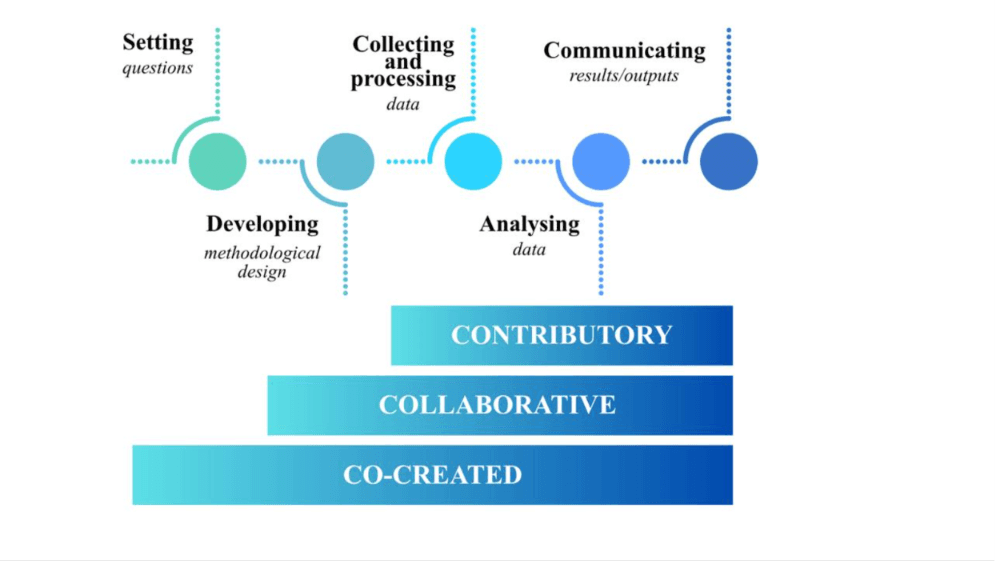
Defining citizen science with precision remains contested. The practice is sometimes described as any process in which unpaid volunteers contribute to scientific inquiry, but this characterisation obscures significant variation in participant roles, project governance, and epistemic assumptions. Haklay identifies multiple models of citizen participation that differ in the stages of the research process where citizens are involved. In contributory projects, citizens function primarily as data collectors, with researchers retaining control over question design, analysis, and dissemination. Collaborative projects extend participation further: citizens may contribute to study design and data analysis, though the research agenda remains largely researcher-led. Co-created projects involve citizens in every stage, from formulating research questions to disseminating findings, and are typically local in scale precisely because the depth of engagement they require limits geographic reach.
Figure 1 illustrates how these three models differ in the breadth of citizen involvement across the scientific process.
This diversity matters for sustainability management. A contributory project that maps sanitation access across informal settlements generates different types of value than a co-created study examining community perceptions of water quality. Both are legitimate; neither is sufficient alone. The distinction also clarifies the limits of treating citizen science as a unified practice. Challenges of data quality, participant motivation, and institutional integration vary depending on project type, scale, and disciplinary context.
Two organising perspectives dominate the recent literature. The first treats citizen science primarily as a tool for expanding scientific productivity: volunteers extend data-collection capacity, cover geographies that professional teams cannot reach, and process datasets at volumes that are impossible for small research groups. The second perspective foregrounds democratisation: citizen science as a means of opening the production of knowledge to those whose lives are affected by its applications, incorporating local and experiential knowledge that formal science often excludes. These perspectives are not mutually exclusive. Integrative positions have been proposed that see citizen science as a mechanism for supporting just transitions by linking data generation, agenda setting, and capacity building within affected communities.
There is also the question of overlapping terminology. The same practices are described in different contexts as community science, participatory mapping, civic science, voluntary geographic information, and citizen observatories, among other labels. The proliferation of terms reflects genuine disciplinary variation, but it complicates cross-field synthesis and policy recognition. For the purposes of this article, citizen science refers to processes in which members of the public independently gather, process, or analyse data about their environment and social conditions, in collaboration with researchers or institutions.
The adoption of the SDGs in 2015 created both an opportunity and a stress test for citizen science. The 2030 Agenda requires high-quality, timely, and disaggregated data across 169 targets and 231 indicators, much of which does not exist in national statistical systems. At the same time, the agenda explicitly calls for broad societal participation, not just as a means of monitoring compliance, but as a condition for the transformative change the goals require.
Citizen science can contribute across three interconnected functions: defining context-specific targets, monitoring progress, and supporting implementation. In target definition, many SDG formulations require local interpretation before they can be operationalised. SDG Target 7.1, which commits to universal access to "affordable, reliable, and modern" energy services, contains criteria that vary substantially across geographic, cultural, and economic contexts. Citizen science methods, particularly co-created qualitative approaches, are well-positioned to define what affordability or reliability means for specific communities, especially those that national statistics render invisible. This function is underutilised in current SDG implementation.
Monitoring represents the most extensively documented contribution. SDG Target 6.2 (equitable sanitation and hygiene) illustrates the point well. Crowdsourcing platforms such as Epicollect and OpenDataKit have been deployed to map the location and functionality of sanitation facilities at local scales where national household surveys provide only coarse, often outdated coverage. Similar approaches have been applied to water quality monitoring, biodiversity tracking, and air pollution mapping. The Community Collaborative Rain, Hail and Snow Network (CoCoRaHS) and Freshwater Watch are established examples of citizen-generated environmental datasets that complement official monitoring systems.
Implementation goes beyond monitoring. Citizen science generates social outcomes alongside data: participants gain environmental literacy, develop networks, and sometimes become advocates for the very issues they study. A co-created project on waste management in a Palestinian refugee camp illustrates this dynamic well. Designed with camp residents rather than for them, the project produced data on household waste generation that supported a local case for recycling infrastructure while also building community capacity for environmental action. This kind of embedded citizen science, where participation shapes both the evidence and the actors who use it, is particularly relevant for SDG 17, which emphasises partnerships and shared responsibility as conditions for achieving all other goals. Despite these contributions, citizen science currently represents only a small fraction of the data infrastructure informing SDG reporting. The gap between its demonstrated potential and its actual uptake reflects institutional rather than technical constraints, a point taken up in the following section.
Two concerns recur in critiques of citizen science: data quality and statistical validity. Both are legitimate, and neither is insurmountable. The evidence from well-designed projects shows that citizen-collected data is comparable in quality to that gathered by professional scientists when protocols are clear, training is provided where necessary, and data is screened at the point of submission. Statistical validity is a more complex problem, particularly for self-selecting participant groups and projects where participants have a stake in the outcomes. Analytical techniques for controlling uneven sampling have advanced considerably, and targeted recruitment can improve representativeness for specific populations. These are design problems, not fundamental objections.
More consequential, though less often discussed, are the structural conditions that constrain citizen science at scale. First, academic institutions continue to undervalue citizen science as a research practice. Career incentive structures reward publications in high-impact journals, not community partnerships or public datasets. Researchers who invest in co-created projects frequently absorb costs that the evaluation system does not compensate.
This is a systemic problem that requires changes in how research performance is defined and assessed, not adjustments to individual research programs.
Second, the metrics used to evaluate scientific impact do not capture the social outcomes that citizen science often produces most reliably. Changes in participant knowledge, attitude, and behaviour; contributions to local decision-making; and the building of trust between scientific institutions and communities are not well-represented in citation counts or journal impact factors. Better evaluation frameworks are needed, ones designed for the purposes citizen science actually serves.
Third, equitable participation requires active investment. The assumption that citizen science is inherently inclusive because it is open to anyone ignores structural barriers of time, technology access, language, and institutional trust. Many of the populations most relevant to SDG achievement, marginalised communities, people without reliable digital access, and groups with historical reasons to distrust formal institutions, are the least likely to participate under default conditions. Reaching these groups requires resources and deliberate design choices, and the resulting data, even if not always comparable with national datasets, provides information about their experiences and needs that no other method easily generates.
The evidence available supports a direct conclusion: realising the contributions that citizen science can make to sustainability management requires intentional policy action, not simply goodwill. Policymakers at national and international levels need to formally incorporate citizen science into science, technology, and innovation strategies. This means committing to long-term funding for infrastructure, defining data standards that allow citizen-generated data to be integrated with official datasets, and establishing governance frameworks that protect participant privacy and data rights. High-level endorsement creates the enabling conditions under which networks, intermediary organisations, and local initiatives can operate effectively.
Co-operation across sectors and scales is not optional. Successful citizen science programs consistently combine top-down institutional support with bottom-up energy from communities, NGOs, and civil society groups. Networks such as the Eye on Earth Alliance and CIVICUS DataShift have demonstrated the value of intermediary organisations that connect actors, aggregate resources, and build shared capacity. International collaboration on data standards and monitoring protocols extends this logic to global challenges where fragmented, incomparable datasets limit collective action.
The interface between citizen science and the SDGs is not automatic. It requires translation work: connecting community-level data to national reporting mechanisms, aligning citizen science protocols with official indicator definitions, and building relationships between statistical offices and citizen science practitioners. This work is underway in some contexts and entirely absent in others. The unevenness reflects the current state of a field that has moved faster in its epistemic ambitions than in its institutional embedding.
Citizen science occupies an increasingly significant position in the architecture of sustainability governance. It expands the geographic and social reach of data collection, incorporates forms of knowledge that formal science overlooks, and generates participant capacities that outlast any individual project. Its fit with the SDG framework is genuine and well-documented, spanning the full cycle from target definition through monitoring to implementation.
The field's limitations are real but addressable. Data quality concerns are manageable through good design; statistical limitations are narrowing as analytical methods improve; participation gaps require deliberate effort but are not inherent to the practice. What citizen science cannot resolve on its own are the institutional barriers that currently limit its scale and integration: incentive structures that disadvantage researchers who engage the public, evaluation frameworks that ignore social impact, and funding models that favour short cycles over the sustained relationships that co-created science requires.
The path forward involves systemic change in how research is valued and supported, not only in better citizen science projects. Both are needed. The evidence base is sufficient to act on; what remains is the political and institutional commitment to do so.
• Bonney, R., Cooper, C. B., Dickinson, J., Kelling, S., Phillips, T., Rosenberg, K. V., & Shirk, J. (2009). Citizen science: A developing tool for expanding science knowledge and scientific literacy. BioScience, 59(11), 977–984. https://doi.org/10.1525/bio.2009.59.11.9
• Bonney, R., Phillips, T. B., Ballard, H. L., & Enck, J. W. (2016). Can citizen science enhance public understanding of science? Public Understanding of Science, 25(1), 2–16. https://doi.org/10.1177/0963662515607406
• Crall, A. W., Newman, G. J., Stohlgren, T. J., Holfelder, K. A., Graham, J., & Waller, D. M. (2011). Assessing citizen science data quality: An invasive species case study. Conservation Letters, 4(6), 433–442. https://doi.org/10.1111/j.1755-263X.2011.00196.x
• Dunning, C., & Kalow, J. (2016). SDG indicators: Serious gaps abound in data availability. Center for Global Development. https://www.cgdev.org/blog/sdg-indicators-serious-gaps-abound-data-availability
• Fraísl, D., et al. (2020). Mapping citizen science contributions to the UN Sustainable Development Goals. Sustainability Science, 15, 1735–1751. https://doi.org/10.1007/s11625-020-00833-7
• Haklay, M., et al. (2021). Contours of citizen science: A vignette study. Royal Society Open Science, 8, 202108. https://doi.org/10.1098/rsos.202108
• Hall, D. M., Gilbertz, S. J., Anderson, M. B., & Ward, L. C. (2016). Beyond "buy-in": Designing citizen participation in water planning as research. Journal of Cleaner Production, 133, 725–734. https://doi.org/10.1016/j.jclepro.2016.05.170
• Irwin, A. (1995). Citizen science: A study of people, expertise and sustainable development. Routledge.
• Irwin, A. (2015). Citizen science and scientific citizenship: Same words, different meanings? In B. Schiele, J. Le Marec, & P. Baranger (Eds.), Science communication today: Current strategies and means of action (pp. 29–38). Presses Universitaires de Nancy.
• Kosmala, M., Wiggins, A., Swanson, A., & Simmons, B. (2016). Assessing data quality in citizen science. Frontiers in Ecology and the Environment, 14(10), 551–560. https://doi.org/10.1002/fee.1436
• Kullenberg, C., & Kasperowski, D. (2016). What is citizen science? A scientometric meta-analysis. PLOS ONE, 11, e0147152. https://doi.org/10.1371/journal.pone.0147152
• OECD. (2025). Embedding citizen science into research policy. OECD Publishing. https://doi.org/10.1787/a1cfb1a8-en
• Shirk, J. L., et al. (2012). Public participation in scientific research: A framework for deliberate design. Ecology and Society, 17, 29. https://doi.org/10.5751/ES-04705-170229
• Skarlatidou, A., & Haklay, M. (2021). Citizen science impact pathways for a positive contribution to public participation in science. JCOM, 20(06), A02. https://doi.org/10.22323/2.20060202
• Souto, R. D., & Batalhão, A. C. S. (2022). Citizen science as a tool for collaborative site-specific oil spill mapping: The case of Brazil. Anais da Academia Brasileira de Ciências, 94, e20211262. https://doi.org/10.1590/0001-3765202220211262
• Tauginienė, L., et al. (2020). Citizen science in the social sciences and humanities: The power of interdisciplinarity. Palgrave Communications, 6, 89. https://doi.org/10.1057/s41599-020-0471-y
• United Nations. (2015). Transforming our world: The 2030 Agenda for Sustainable Development. United Nations.